
What if the biggest risk to your business relocation isn’t the heavy lifting, but the fine print you haven’t read yet? With 60% of Australian commercial lease disputes now involving disagreements over make-good obligations, the stakes for your next transition have never been higher. You’re likely feeling the weight of coordinating complex IT infrastructure while trying to keep staff anxiety at bay, all while fearing that one lost crate could derail your entire week’s productivity.
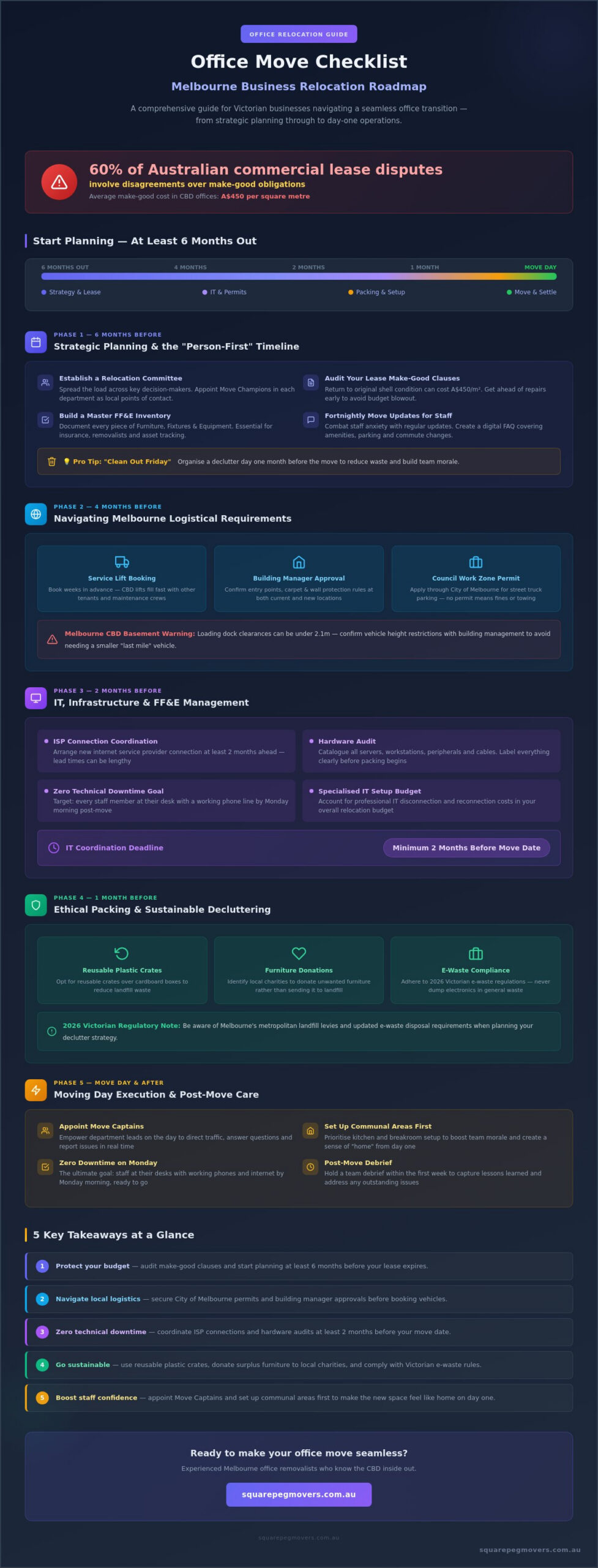
We understand that a successful relocation is about more than just boxes; it’s about people and continuity. That’s why we’ve developed a comprehensive office move checklist Melbourne leaders can rely on for a seamless transition. Our roadmap ensures your equipment stays safe and your operations remain steady throughout the entire process.
In this guide, we’ll navigate the specific 2026 requirements for Victorian businesses, including the latest metropolitan landfill levies and essential e-waste regulations. You’ll learn exactly how to manage the logistics so your team is settled and back at their desks by Monday morning, ready for work with zero downtime and total peace of mind.
Key Takeaways
- Protect your budget by auditing “make good” clauses and starting your strategic planning at least six months before your lease expires.
- Navigate local logistics with our office move checklist Melbourne, ensuring you have the correct City of Melbourne permits and building manager approvals in place.
- Ensure zero technical downtime by coordinating ISP connections and hardware audits at least two months prior to your scheduled move date.
- Adopt a sustainable approach by using reusable plastic crates and identifying local charities for furniture donations to reduce landfill waste.
- Boost staff confidence on day one by appointing Move Captains and prioritising the setup of communal areas like the kitchen and breakroom.
Phase 1: Strategic Planning and the “Person-First” Timeline
Planning a business relocation in the Melbourne CBD or surrounding suburbs isn’t a weekend project. It’s a complex strategic operation that should begin at least four to six months before your current lease expires. This lead time allows you to establish a relocation committee of key decision makers. By starting early, you ensure the logistical weight doesn’t fall on a single person’s shoulders, allowing your leadership team to focus on business continuity rather than just boxes.
One of the most critical steps in your office move checklist Melbourne is a thorough review of your current commercial lease. You must look specifically for “make-good” clauses. These requirements often mandate that you return the space to its original shell condition, which can be a massive hidden expense. Given that 60% of Australian commercial lease disputes involve these obligations, and the average cost for make-good in Australian CBD offices sits at approximately A$450 per square metre, getting a head start on repairs can prevent a significant budget blowout. Early assessment gives you the leverage to negotiate or find cost-effective contractors before the clock runs out.
Professional Relocation services often suggest that a master inventory is the backbone of a stress-free move. You’ll need to document every piece of Furniture, Fixtures, and Equipment (FF&E). This list doesn’t just help your removalists; it’s your primary tool for insurance and asset tracking. We recommend appointing “Move Champions” in each department. These individuals act as local points of contact, ensuring that specific team needs aren’t lost in the broader shuffle and that communication remains clear across the entire organisation.
Setting Your Relocation Goals
Clear goals prevent “scope creep” during a move. You might decide that success means every staff member is back at their desk with a working phone line by Monday morning with zero Friday downtime. When you establish your budget, be sure to account for specialised IT setup and professional packing services. A single, clear sentence defining the move timeline should be shared with all stakeholders to keep everyone on the same page.
The Internal Communication Strategy
Staff anxiety is a real productivity killer during a transition. You can combat this by scheduling fortnightly “Move Updates” to keep everyone informed. Create a digital FAQ that covers the new office’s amenities, such as nearby cafes, parking availability, or changes to the morning commute. To make the process lighter, organise a “Clean Out Friday” a month before the move. It’s a great way to encourage early decluttering while building a sense of shared purpose among the team.
Phase 2: Navigating Melbourne Logistical Requirements
Once your strategy is set, the focus shifts to the physical environment of the city. Moving an office in the Melbourne CBD or Docklands presents hurdles that simply don’t exist in suburban business parks. To keep your transition smooth, your office move checklist Melbourne must prioritise building access and council regulations from the outset. This isn’t just about getting from point A to point B; it’s about understanding the specific rules that govern our city’s streets and skyscrapers.
Your first conversation should be with the building managers at both your current and future locations. Every commercial site has its own set of rules, from specific entry points to mandatory protection for carpets and walls. You’ll need to book the service lift well in advance. In high-occupancy buildings, these lifts are often booked out weeks ahead by other tenants or maintenance crews. Don’t forget to check the height clearances for basement loading docks. CBD basements can be notoriously low, sometimes under 2.1 metres, which may require your removalist to use smaller vehicles for the “last mile” of the move.
If your move requires street parking for a truck, you’ll likely need to apply for a “Construction/Work Zone” permit from the City of Melbourne. This is a common requirement in areas where loading zones are scarce or traffic flow is high. Failing to secure these permits can lead to heavy fines or, even worse, your moving truck being towed mid-process. For a truly stress-free experience, you might consider booking professional office removals who understand these local nuances and can help manage the logistical heavy lifting.
CBD and Inner-Suburb Access
Melbourne’s “Little” streets and narrow laneways require a driver with precision and local knowledge. You must also account for clearway times on major arteries like St Kilda Road or Victoria Parade. If your truck is caught in a clearway, the move stops instantly. Building managers will also require your removalist to provide a certificate of currency for public liability insurance, typically at least 48 hours before the truck arrives on-site.
Loading Dock Etiquette
Most commercial loading docks in Melbourne operate strictly between 6 am and 6 pm. Outside these hours, you may find yourself locked out. It’s also wise to measure the walking distance from the loading dock to the lift. A long corridor can significantly increase labour time and costs. In high-traffic zones like Southbank, be vigilant about “No Stopping” or “Loading Zone” restrictions; the local council is very active in these areas, and they don’t give warnings to idling trucks.
Phase 3: IT, Infrastructure, and FF&E Management
Your technology is the nervous system of your business. If it fails, your operations grind to a halt. As part of a robust office move checklist Melbourne, you must begin a comprehensive audit of all IT hardware, servers, and telephony at least two months before the big day. This isn’t just about counting laptops; it’s about evaluating the health of your infrastructure and deciding what actually deserves a spot in the new office. Use this time to retire legacy hardware that no longer serves your team’s needs.
Coordinate with your Internet Service Provider (ISP) as early as possible. High-speed internet must be live and tested at the new site at least 48 hours before your team arrives. There is nothing more detrimental to staff morale than a team sitting at their desks on Monday morning unable to log in. You should also map out every power and data point on your new floor plan. Identifying these locations early prevents the trip hazards and aesthetic mess of “daisy-chained” power boards and loose cables running across the carpet.
Develop a “Critical Tech” plan for your servers and sensitive data storage. These components are the lifeblood of your business and require a higher level of care than a standard desk chair. Always ensure you have a verified, off-site backup of all data before a single cable is unplugged. This creates a safety net that protects your business from the unexpected, giving you total peace of mind during the physical transition.
Protecting Sensitive Electronics
Computers and monitors are fragile and sensitive to static. Use specialised anti-static wrapping for server components to prevent internal damage during transit. We recommend the “One Bag per Desk” rule. All cables for a specific workstation should be labelled, disconnected, and placed into a single, clearly marked bag. This simple step saves hours of frustration during the re-setup phase. For these high-value assets, you should engage professional FF&E transport specialists who understand the unique requirements of delicate hardware.
The Floor Plan Blueprint
A successful move depends on where things go, not just how they get there. Number every desk and office sequentially on your new floor plan to match the labels on your removalist’s manifest. Mark “Common Areas” and “Quiet Zones” clearly to help the crew place communal furniture without constant supervision. If you have oversized items like boardroom tables or heavy safes, identify them now. These pieces often require specialised lifting gear or additional manpower to navigate Melbourne’s commercial lifts safely.
Phase 4: Ethical Packing and Sustainable Decluttering
Moving an office generates a mountain of waste. It doesn’t have to be that way. An ethical office move checklist Melbourne businesses can be proud of starts with a commitment to the planet. Instead of relying on single-use cardboard boxes that often end up in landfill after one use, we advocate for a “Zero Waste” move policy. This involves using reusable materials that provide better protection for your assets while keeping our city clean. It’s a simple shift that makes a massive difference to your corporate social responsibility profile.
Standardising your packing process is a vital part of any office move checklist Melbourne managers follow. Before the first crate is packed, ensure your team understands the labelling hierarchy: Department > Desk Number > Contents. This clarity allows removalists to place items precisely where they need to be. It reduces the time your staff spends hunting for their stapler on Monday morning and keeps the momentum of the move high.
The SQUAREpeg Rental Box Advantage
One of the easiest ways to meet your sustainability goals is through sustainable moving box rentals. Plastic crates are far superior to cardboard for commercial relocations. They’re crush-proof, weather-resistant, and stack perfectly. This means your sensitive office equipment stays safe even if the truck encounters roadworks or heavy traffic on the Monash. We’ve made the process effortless by offering delivery and pickup services directly to your Melbourne office, so you don’t have to worry about storage or disposal once you’ve unpacked.
Ethical Disposal of Office Assets
Decluttering is a necessary evil of moving. However, simply tossing old monitors or broken chairs into a skip bin is no longer an acceptable standard. In Victoria, it’s illegal to send e-waste to landfill, and the metropolitan landfill levy for 2025-2026 is $169.79 per tonne. This makes ethical disposal a financial necessity as well as a moral one. Reach out to local Melbourne charities or social enterprises for furniture that’s still in good condition. Schools and non-profits are often looking for quality desks and chairs. We recommend planning this disposal at least four weeks before your move date. This prevents the “skip bin scourge” where items are discarded in a last-minute panic.
Don’t forget the paper trail. Organise a secure document shredding service for any sensitive files that no longer require physical storage. This protects your business and clears out unnecessary bulk before the truck arrives. If you’re ready to streamline your packing, visit our Rental Box Store to secure your reusable crates today.
Phase 5: Moving Day Execution and Post-Move Care
The big day has arrived. After months of planning and auditing your office move checklist Melbourne, it’s time to execute the physical transition. To keep things orderly, assign a “Move Captain” at both the origin and the destination. These individuals act as the primary liaison for the removalists, ensuring that questions are answered quickly and the flow of crates remains steady. While one captain oversees the final clearing of the old site, the other manages the arrival and placement of furniture at the new office, preventing bottlenecks at the service lift.
Before the last truck departs, perform a final walkthrough of your old premises. Check the back of cupboards, storage rooms, and the server rack one last time. This is also the moment to ensure the space meets the “make-good” standards discussed in Phase 1, avoiding any last-minute disputes with your landlord. Once you arrive at the new site, prioritise the setup of the kitchen and breakroom. It might seem small, but having a functional space for a coffee or a quick lunch on day one significantly boosts staff morale and makes the new environment feel like home immediately.
Before the first employee walks through the door on Monday morning, conduct a rigorous “Tech Check” on every workstation. Verify that monitors are connected, keyboards are responsive, and the ISP connection is as fast as promised. Resolving these minor teething issues over the weekend ensures your team can hit the ground running without technical frustration. This final step in your office move checklist Melbourne is what separates a chaotic move from a professional transition.
The “Welcome Home” Experience
A successful move is as much about the people as it is about the equipment. You can ease the transition by placing a small “Welcome to our new home” kit on every desk. Include essentials like a pass for the new building and a local map highlighting the best nearby coffee shops or lunch spots in the CBD or Southbank. Schedule a brief “Stand-up Meeting” on Monday morning. This gives your team a chance to ask questions and allows you to address any minor issues in a calm, supportive environment.
Why SQUAREpeg is Your Reliable Melbourne Partner
At the heart of every business relocation is a need for trust and transparency. We take a person-first approach to office removals, recognising that we aren’t just moving desks; we’re moving your team’s livelihood. Our commitment to social responsibility and ethical moving practices means we care as much about the environment and our community as we do about your bottom line. We invite you to reach out for a transparent, fixed-quote for your next relocation, ensuring you have a principled guide for your journey to a new workspace.
Step into Your New Melbourne Workspace with Confidence
Relocating your business is a significant milestone that requires balancing technical precision with staff wellbeing. By following this office move checklist Melbourne, you’ve secured a path to zero downtime; from managing “make-good” lease obligations to ensuring your IT infrastructure is live before Monday morning. You’ve also made a choice for the planet by prioritising sustainable packing and ethical asset disposal.
Success depends on having a partner who values your peace of mind as much as your equipment. We offer specialised high-care FF&E transport and a commitment to total transparency with no hidden depot fees. When you move with us, you’re also contributing to a greater purpose through our ongoing support for charitable projects in Cambodia and Ethiopia.
Get a transparent, fixed quote for your Melbourne office move today. Your new office is more than just a change of address; it’s a fresh start for your entire team. We’re here to make sure it begins on the right foot.
Frequently Asked Questions
How far in advance should I book an office move in Melbourne?
You should aim to book your professional removalist at least 8 to 12 weeks before your planned move date. While the strategic planning in our office move checklist Melbourne starts much earlier, securing your preferred dates is vital for business continuity. High-demand periods, particularly around the end of the financial year, often see reputable movers booked out months in advance. Booking early allows you to coordinate building access and lift bookings without unnecessary stress.
Do I need a council permit to park a moving truck in the Melbourne CBD?
Yes, you will likely need a “Construction/Work Zone” permit or a “Reserve a Parking Space” permit from the City of Melbourne if you require dedicated street access. This is particularly important for CBD streets and narrow laneways where loading zones are restricted or non-existent. You should check the specific requirements for your street address on the council website at least four weeks before the move. Failing to secure these permits can lead to significant fines.
How can I minimise business downtime during our office relocation?
The most effective way to minimise downtime is to schedule your physical move over a weekend, ensuring your IT infrastructure is live by Sunday evening. This allows your staff to leave their old desks on Friday afternoon and arrive at a fully functional workspace on Monday morning. By prioritising the setup of servers and high-speed internet connections 48 hours before the team arrives, you eliminate the technical hurdles that typically derail productivity during a transition.
What is the best way to move sensitive IT equipment and servers?
You should always use anti-static wrapping and specialised high-care FF&E transport for all servers and sensitive hardware. Standard removalist blankets aren’t enough for delicate electronics that are sensitive to vibration and static. We recommend labelling and bagging every workstation’s cables individually to speed up the re-installation process. Always ensure a verified, off-site backup of all data is completed before any equipment is disconnected or moved to prevent any potential data loss.
Should I use cardboard boxes or rental crates for an office move?
Reusable plastic rental crates are the superior choice for commercial relocations due to their durability and environmental benefits. Unlike cardboard, plastic crates are crush-proof and stack securely, providing much better protection for expensive office equipment. They also help you meet your sustainability goals by eliminating the waste associated with single-use boxes. Our rental box store provides delivery and collection services, so you don’t have to worry about storing or disposing of bulky cardboard after you’ve unpacked.
How do I handle the disposal of old office furniture ethically in Melbourne?
You should partner with local e-waste recyclers and charitable organisations to ensure your surplus assets don’t end up in landfill. In Victoria, sending e-waste to landfill is illegal; furthermore, metropolitan landfill levies for 2025-2026 are $169.79 per tonne. Planning your disposal four weeks out allows you to find schools or non-profits that can reuse your quality furniture. This approach reduces your environmental footprint while supporting the local community and avoiding high commercial waste fees.
What insurance do I need for a commercial office move?
You should verify that your removalist holds comprehensive public liability insurance and specific transit insurance for your assets. Most building managers in the Melbourne CBD will require a certificate of currency for public liability insurance before allowing any work to commence on-site. While your existing business insurance might cover some items, transit insurance specifically protects your equipment against damage or loss during the physical move. It is a small investment that provides essential peace of mind.
Can removalists help with the packing and unpacking of workstations?
Yes, professional office removalists offer comprehensive packing and unpacking services tailored to commercial workstations. Engaging a team for specialised office packing can save your staff hours of labour and reduce the risk of injury. Professional packers use standardised labelling systems to ensure every item arrives at the correct desk. This service allows your team to focus on their core roles while we handle the logistical heavy lifting of the physical transition.